White diamonds are only the beginning. The combinations are where the design lives.
A diamond on its own is pure light. Pair it with colour, and suddenly there is a conversation — between fire and depth, between white and whatever hue sits beside it. This is where jewellery becomes design rather than display.
Alternating, not accenting
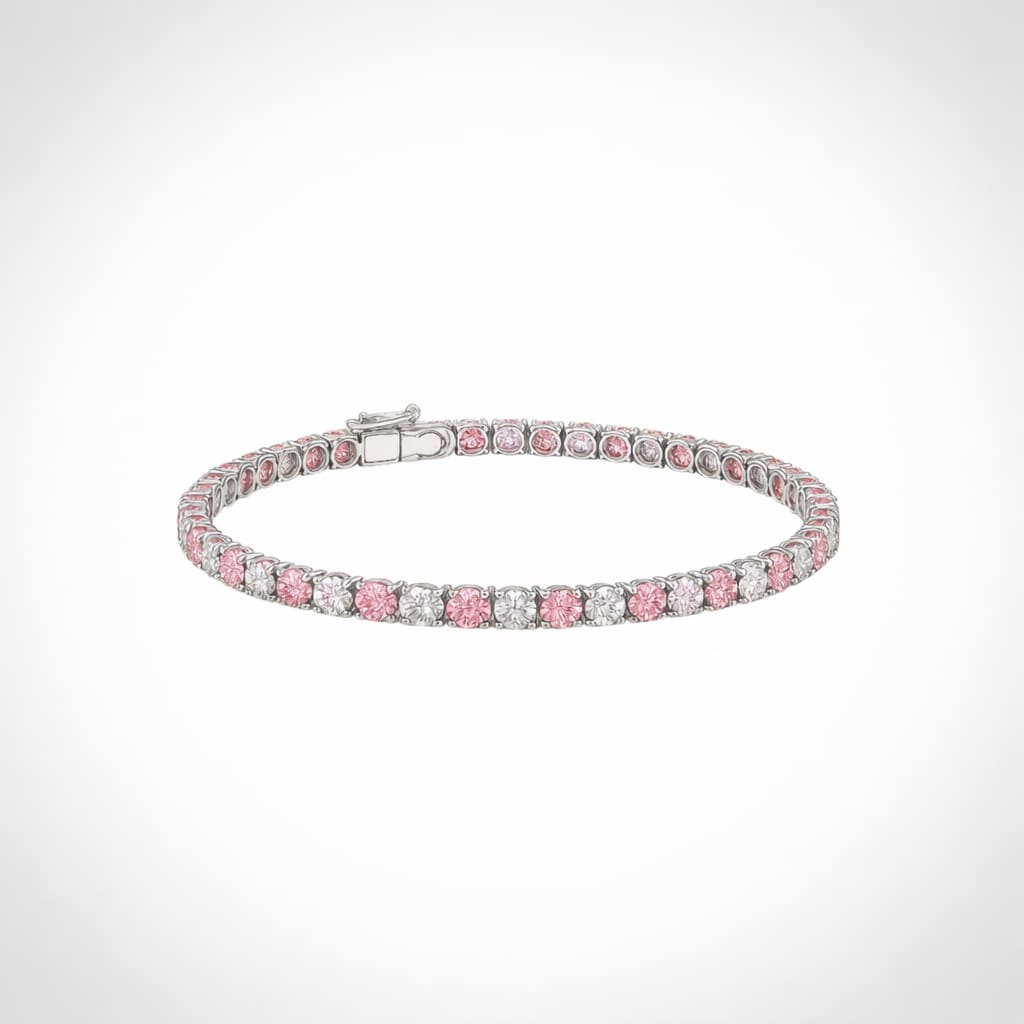
The combination we return to most is also the simplest: a line of white stones interrupted at intervals by a coloured one. The Cherry bracelet alternates pink and white; Iris does the same in blue. Neither reads as a coloured piece. They read as white pieces with a pulse.
It works because the eye registers the rhythm before it registers the colour. Worn against skin, at a distance, you see a bracelet catching light. Up close, you see the decision.
Laura takes the same idea into a tennis necklace, in pink and white lab-grown diamond rather than moissanite — the effect is quieter, because the pinks are paler, and it sits closer to the skin where the difference is easiest to see.
A coloured centre
The other approach is to put the colour at the centre and let white diamonds hold it. The Harper ring does this with a pink lab-grown diamond in a cushion halo: the halo does the sparkling, and the centre stone does the talking.
This is the more demanding of the two, because everything now depends on the one stone. A centre stone that is slightly off in tone will look like a mistake rather than a choice, which is why we hand-select these rather than order to a specification.
Let the metal decide
Colour behaves differently against different golds, and this is the part most people underestimate. Warm stones — pink, champagne, anything on the red side — settle beautifully into yellow gold and can look faintly washed against white. Cool stones hold their edge in white gold and fight slightly with yellow.
Rose gold sits between the two and flatters almost any warm stone, which is why it is a safe answer when someone is unsure.
If you are drawn to colour but do not know where to begin, start with what you already wear. The metals, the tones, the pieces already in your wardrobe will tell you which gem belongs against your skin — and they are a better guide than anything we could recommend from here.
Colour as meaning
Colour also lets a piece carry meaning. A birthstone, a favourite hue, a stone chosen for the person rather than the trend. The combination becomes the story, and the story is usually why the piece gets worn rather than kept.
Beyond what is in the collection, coloured stones are commission territory — sapphire beside a lab-grown diamond, cool and architectural; emerald against white, almost luminous. Those we source per piece, which is the honest way to do it: matched to your design rather than fitted to whatever was already in stock.